Eastrington Primary
Enrich - Enjoy - Excel
Portington Road, Eastrington, Goole. DN14 7QE
To find out where we are visit view a map on our Contact Us page.
Maths
Mathematics
Subject Coordinator- Mrs Laura Welbourne
Intent
Mathematics is an important skill in everyday life and, with this is mind, the purpose of Mathematics at Eastrington Primary School is to encourage and develop a love of maths whilst teaching pupils to be confident, fluent mathematicians who have an ability to solve problems, to reason, to think logically and to work systematically and accurately.
Mathematics is taught progressively and sequentially and begins in Nursery. All children are challenged and encouraged to excel in Maths. Mathematical concepts are introduced using a ‘Concrete, Pictorial and Abstract’ approach; enabling all children to experience hands-on learning when discovering new mathematical topics, and allowing them to have clear models and images to aid their understanding. Arithmetic and basic math skills are practised daily to ensure key mathematical concepts are embedded and children can recall this information to see the links between topics in Maths.
Implementation
• At Eastrington Primary School lessons are planned and sequenced so that new knowledge and skills build on what has been taught before.
• Teachers adapt the White Rose Maths Hub material, Termly Overview and
Schemes of work to support their planning.
• Teachers use Puma termly assessments to track children’s progress and identify gaps in learning.
• A range of reasoning and problem solving resources are used to challenge all children and give them the opportunity to reason with their understanding.
• Children who have shown their understanding at a deep level within the unit, will have opportunities to apply these skills in a greater depth activity. These activities are challenging to ensure that children are using more than just one skill and are able to answer the mathematical problem.
• Children on the SEND register for Maths are included in whole class lessons and teachers
provide scaffolding and relevant support as necessary. Individualised interventions are provided and recorded on an intervention tracker.
• Homework is set to develop and review children’s learning.
• The Calculation Policy is used to ensure that teaching of formal methods is progressive whilst understanding that sometimes children find their own efficient methods along the way.

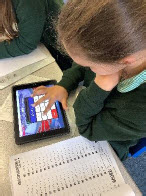
• Children from Year 2- Year 6 have access to their own personal account of ‘Times Tables Rockstar’ where they take part in a carefully sequenced programme of daily times tables practice. This format has been very successful and has boosted the times tables recall speed of our students.
• At Eastrington Primary School we employ a variety of teaching styles and
opportunities for children to learn and develop their Mathematical
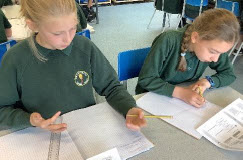
skills and competencies, both individually and collaboratively. The main aim of all lessons is to develop children’s knowledge, understanding and skills so that they know more, remember more and are able to do more.
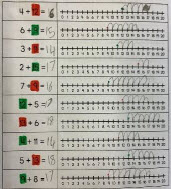
• One of the key elements in lessons throughout the school is developing the children’s mental
calculation strategies alongside developing the children’s
written calculation strategies as laid out in the Calculation Policy.
EYFS:
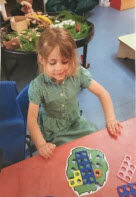
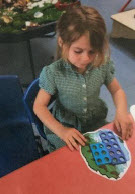
All children in the Foundation Stage have daily opportunities to develop their mathematical understanding, primarily through play and ‘hands on learning’, to meet the requirements of Development Matters. The 2 strands of Mathematics taught in the EYFS are Numbers and Shape, Space and Measure.
By the end of EYFS, we expect the vast majority of our children to achieve the ELGs in Number and Shape, Space and Measure showing that they can:
• Count reliably with numbers from one to 20, place them in order and say which number is one more or one less than a given number.
• Use quantities and objects, to add and subtract two single-digit numbers and count on or back to find the answer.
• Solve problems, including doubling, halving and sharing.
• Use everyday language to talk about size, weight, capacity, position, distance, time and money to compare quantities and objects and to solve problems.
• Recognise, create and describe patterns.
• Explore characteristics of everyday objects and shapes and use mathematical language to describe them.
Impact
As a result of our Maths teaching at Eastrington Primary School you will see:
• Engaged children who are all challenged.
• Confident children who can all talk about Maths and their learning and the links between Mathematical topics.
• Lessons that use a variety of resources to support learning.
• Different representations of mathematical concepts.
• Learning that is tracked and monitored to ensure all children make good progress. • Children demonstrating a quick recall of facts and procedures. This includes the recollection of the times table. • Children showing confidence in believing that they will achieve. • Children being able to recognise relationships and make connections in maths lessons. • Mathematical concepts or skills are mastered when a child can show it in multiple ways, using the mathematical language to explain their ideas, and can independently apply the concept to new problems in unfamiliar situations. • Children showing a high level of pride in the presentation and understanding of the work • Children who know more, remember more and are able to do more.
Let's Talk About School




A wonderful environment in which to learn, play and grow.